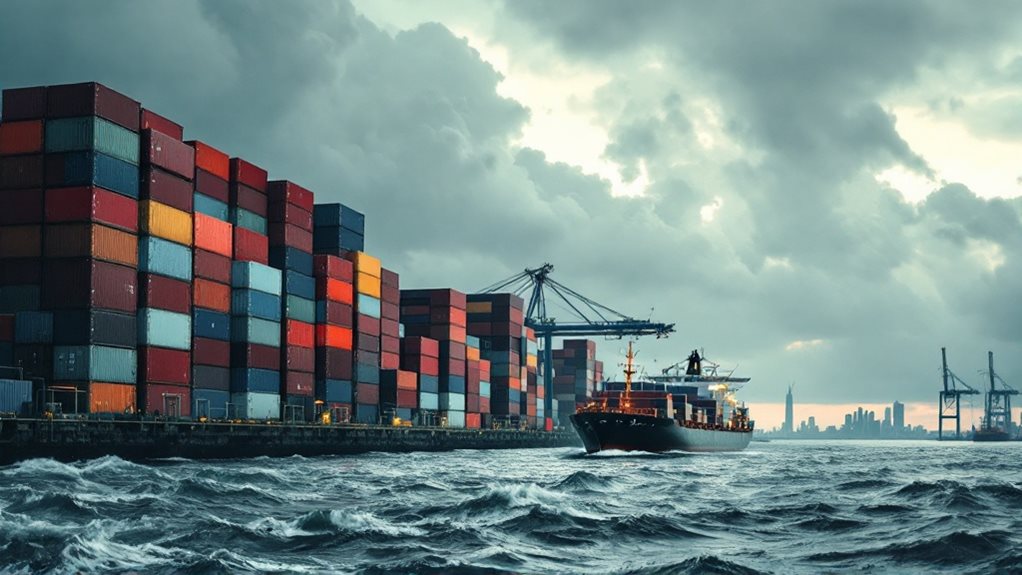

China has issued a sweeping demand for the United States to completely dismantle tariffs imposed during the Trump administration, marking a significant escalation in the ongoing trade tensions between the world’s two largest economies.
Beijing insists that meaningful dialogue cannot resume until Washington abandons what Chinese officials characterize as “maximum pressure” tactics that have led to tariff rates as high as 145% on Chinese exports.
Beijing demands Washington drop “maximum pressure” approach before trade talks can restart
The tariff battle has created economic ripples on both sides of the Pacific. Despite these trade barriers, China‘s export machine keeps humming along, reaching a record $3 trillion in 2024. It’s like watching someone try to stop a freight train with a garden hose – impressive effort, but the train keeps moving.
Meanwhile, the U.S. continues to grapple with a $300 billion trade deficit with China.
Chinese manufacturers aren’t sitting idle while this economic chess match plays out. They’re pouring $2 trillion into infrastructure investments and diversifying supply chains to reduce American market dependence. Some manufacturers are actively exploring market expansion opportunities to Australia and Europe as alternatives to the uncertain U.S. market.
Think of it as China building multiple emergency exits while the main door remains partially blocked. Their focus has shifted toward high-efficiency products like electric vehicles and solar panels, targeting new global markets. This global strategy requires Chinese companies to navigate complex regulatory frameworks across different jurisdictions, similar to challenges faced by crypto businesses.
The U.S. maintains that these tariffs serve as necessary guardrails against what it perceives as unfair Chinese trade practices. American officials worry that cheaper Chinese goods could flood domestic markets, threatening local industries – fundamentally fearing an economic tidal wave of products washing away American manufacturing.
In response, China hasn’t exactly turned the other cheek. Beijing has implemented retaliatory tariffs up to 125% on American goods and blacklisted certain U.S. companies.
The Trump administration recently made a modest concession by exempting certain technology products from high tariffs, including smartphones, computers, and semiconductors, although this has done little to ease overall tensions.
It’s the economic equivalent of “you stepped on my toe, so I’ll step on yours” – except with trillion-dollar consequences.
As consumers in both countries face higher prices, the global economy watches this heavyweight trade bout with bated breath. China’s message remains clear: no tariff removal, no meaningful trade talks.