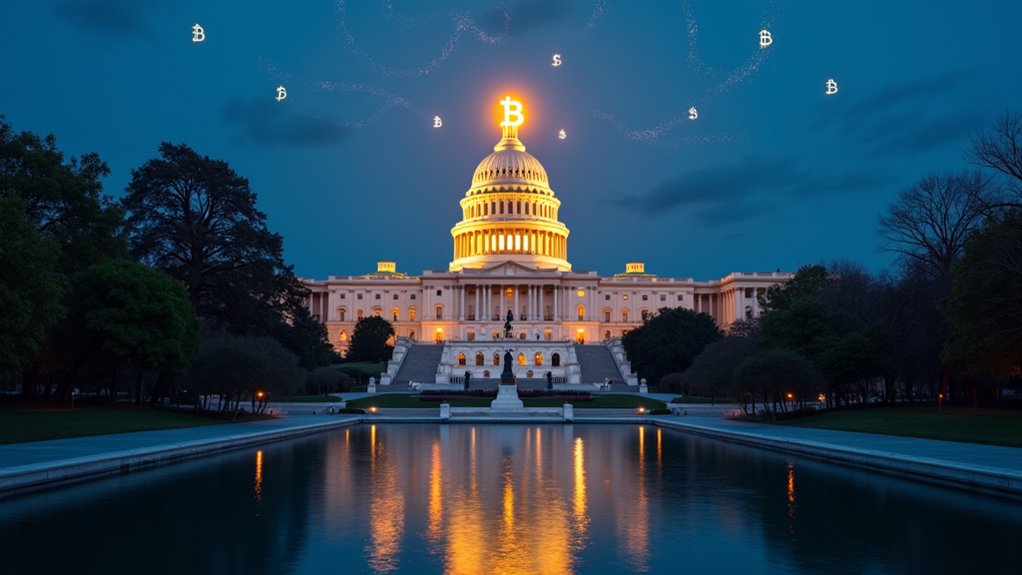

As global markets absorbed the news of a groundbreaking executive order, the U.S. government has positioned itself at the forefront of cryptocurrency adoption by establishing its first Strategic Bitcoin Reserve and Digital Asset Stockpile. This initiative reflects a forward-thinking approach to embracing digital assets for economic growth.
The executive order marks a significant evolution in the government’s approach to digital assets, with Bitcoin being treated as a reserve asset that cannot be sold. The U.S. currently holds an estimated 200,000 Bitcoin, valued at approximately $17.5 billion as of March 2025. However, nearly half of these holdings may belong to Bitfinex, leaving about 100,000 Bitcoin to form the core of the Strategic Reserve. The reserve has been primarily funded through asset forfeiture seizures of cryptocurrencies from criminal activities.
The U.S. government embraces Bitcoin as an untouchable reserve asset, securing 100,000 BTC worth $8.75 billion for its strategic stockpile.
Market reaction to the announcement was initially cautious, with Bitcoin’s price dropping 6% from $90,400 to $84,979. The decline reflected disappointment over the lack of immediate new Bitcoin purchases and broader concerns about potential recession and import tariffs, with analysts suggesting a possible weekly close below $82,000. Experts predict that institutional ETF inflows could drive Bitcoin’s value beyond $150,000 by the end of 2025.
The move has sparked international attention, particularly from China, which reportedly holds 194,000 Bitcoin and is conducting closed-door meetings to discuss its own strategic reserve. This development could trigger a nation-state race for Bitcoin accumulation, as countries worldwide consider similar initiatives.
Looking ahead, the Treasury and Commerce departments are developing budget-neutral strategies for acquiring more Bitcoin. These include potential gold reserve sales, U.S. Treasury Bitbonds issuance, partnerships with U.S. miners for Bitcoin royalties, and exploration of tax incentives for acquisition.
Critics have raised concerns about potential market manipulation by government officials, cryptocurrency volatility, and the absence of “circuit-breaker” mechanisms in crypto markets. The inclusion of altcoins in the stockpile has also been questioned as a potentially risky investment decision.
The executive order represents a cautious yet progressive approach, providing clearer guidelines for the crypto industry while establishing Bitcoin as a strategic asset in the government portfolio. Despite previous costly premature sales that cost U.S. taxpayers over $17 billion, this new policy framework suggests a more measured and long-term oriented strategy for managing digital assets.