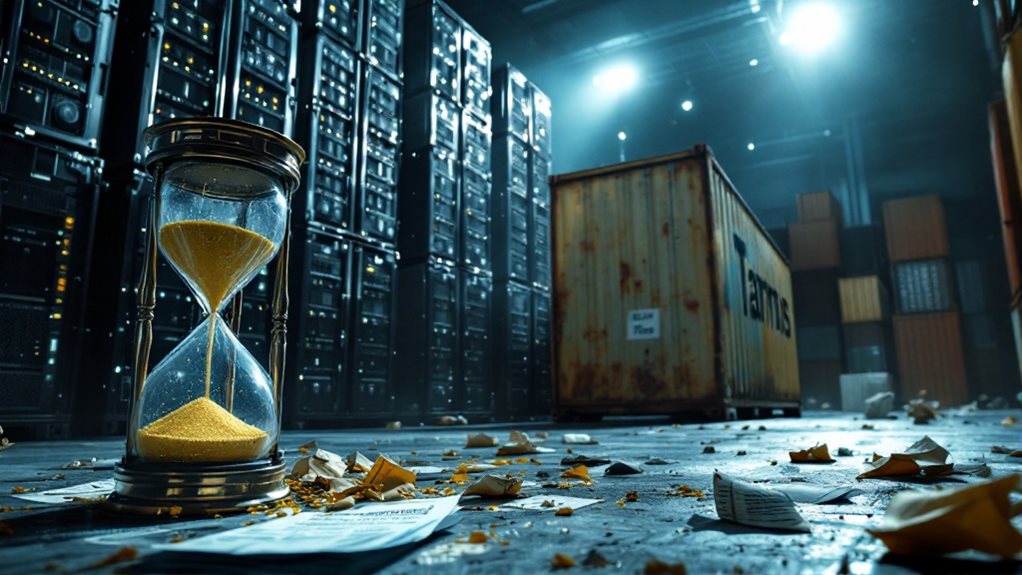

As US Bitcoin miners navigate the rocky terrain of tariffs, they face challenges that could feel akin to trying to ride a bicycle uphill while juggling flaming torches. With tariffs on Chinese mining equipment soaring to a staggering 145%, the stakes are high. This escalating cost landscape could cut into the industry’s annual $4.1 billion contribution to the US GDP and its support of over 31,000 jobs, leaving smaller operators particularly vulnerable. Additionally, the industry has created more than 31,000 jobs across the nation, highlighting its importance in the current economic climate.
The situation is complicated further by the anticipated rise in equipment costs, which could spike between 22% and 36%. Imagine trying to build a sandcastle with a bucket that costs three times more than it should; that’s the reality for miners now. Delays in equipment delivery due to customs inspections add another layer of frustration, creating a perfect storm of inefficiency. Additionally, miners are rushing to import Application-Specific Integrated Circuits (ASICs) to avoid higher costs before tariffs take effect.
Meanwhile, private charter flights to expedite imports can cost firms a staggering $2 to $3.5 million per trip, which might as well be a ticket to a luxury cruise for the amount they spend. The sharp increase in hardware costs makes maintaining a competitive hash rate nearly impossible for smaller mining operations.
As supply chains buckle, miners may find themselves outpaced by competitors abroad. Countries like Russia and Kazakhstan, with fewer trade restrictions, might just steal the show. The uncertainty brought by tariff volatility stifles long-term planning, making the industry feel like a game of musical chairs where the music might stop at any moment.
In a bid to adapt, some companies are stockpiling equipment during tariff pauses, while others are eyeing international expansion. Larger operations are investing in efficiency upgrades and renewable energy, making sustainability a priority.
As Texas, Georgia, and New York thrive with mining investments, the need for predictable policies becomes paramount.
Ultimately, the push for domestic mining, which was championed by previous administrations, now looks like a double-edged sword. Tariffs may have aimed to bolster local operations, but instead, they’ve created a quagmire that could redefine the global mining landscape.