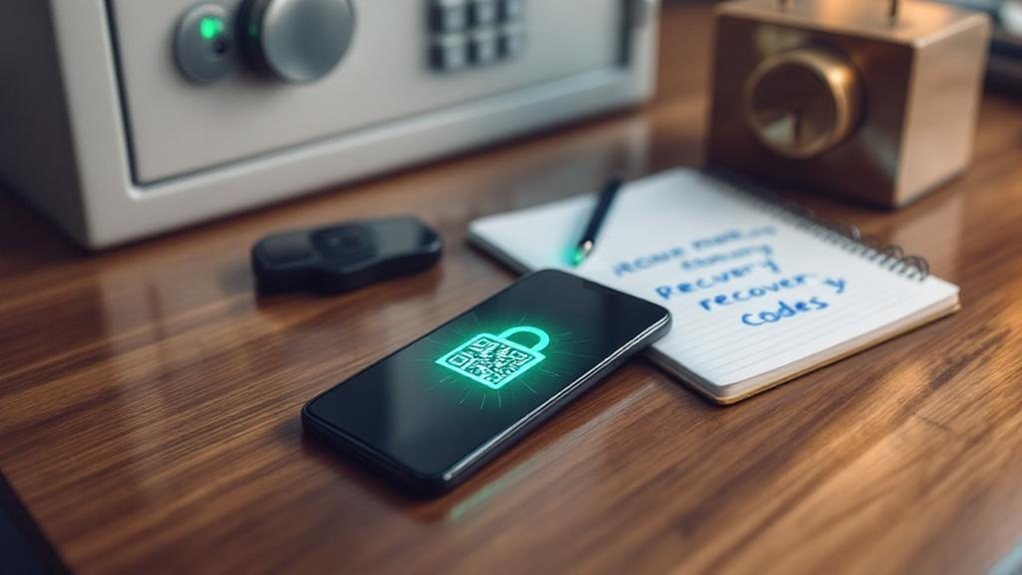

Why do crypto enthusiasts lose access to their hard-earned digital assets despite knowing the risks?
Often, it’s not from lack of awareness but from skipping essential security measures like two-factor authentication (2FA).
Think of 2FA as the bouncer checking both your ID and your secret handshake before letting you into the exclusive crypto club—far more effective than a password alone.
Setting up 2FA isn’t rocket science.
Most major platforms like Binance, Coinbase, and Kraken offer straightforward options in their security settings.
The process typically involves scanning a QR code with an authenticator app, which then generates a fresh 6-digit code every 30 seconds. This mitigates serious risks from stolen passwords through methods like phishing or keylogging.
It’s like having a tiny locksmith inside your phone, crafting new keys that expire faster than a pizza gets cold.
Authenticator apps like Google Authenticator or Authy provide Time-based One-Time Password (TOTP) protection—significantly more secure than SMS-based codes, which are about as private as shouting your password across a crowded room.
SMS codes can be intercepted through SIM-swapping, where hackers convince your carrier they’re you (spoiler alert: they’re not).
When setting up 2FA, backing up your recovery codes is non-negotiable.
Write them down on paper—yes, actual paper—and store them somewhere safe.
Losing access to your authenticator app without backups is the digital equivalent of locking your keys in your car… except the car is filled with money and parked in another dimension.
Hardware security keys like YubiKey offer physical authentication that provides even stronger protection against remote attacks than app-based methods.
Beyond 2FA, avoiding rugpulls requires vigilance.
These exit scams prey on FOMO more than security lapses.
Before jumping into projects, vet the team, check for code audits, and verify liquidity locks.
A glossy website and promises of “moon soon” aren’t substitutes for legitimate security practices.
Staying vigilant with regular security checkups helps identify potential vulnerabilities before scammers can exploit them.
Remember: in crypto, your security habits are the difference between telling “how I got rich” stories and “how I got rekt” cautionary tales.
2FA isn’t just an extra step—it’s your digital bodyguard in the Wild West of cryptocurrency.