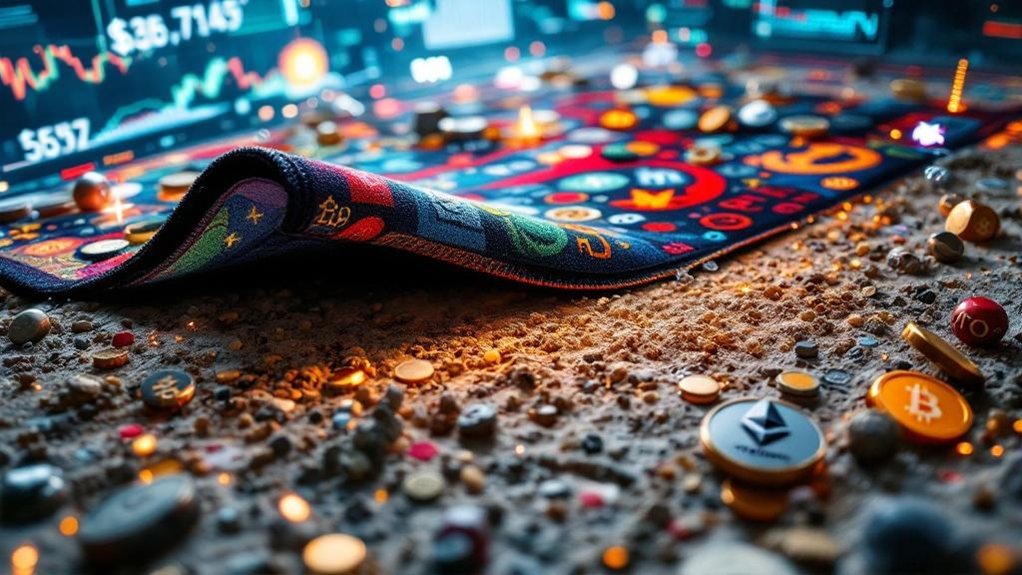

The shadowy underbelly of decentralized finance has given birth to one of cryptocurrency’s most notorious scams: the rug pull.
This exit strategy involves developers suddenly withdrawing all liquidity from a project, leaving investors holding worthless tokens – like yanking a rug from beneath their feet.
Rug pulls thrive in DeFi’s permissionless ecosystem, where anyone can create and list tokens without regulatory oversight.
The typical playbook involves anonymous developers generating social media hype, securing influencer endorsements, and implementing aggressive marketing tactics to attract investor funds before making their escape.
These scams come in different flavors.
Rug pulls manifest in various forms, each employing unique tactics to separate investors from their funds.
Hard rug pulls involve deliberate code-level exploits, such as preventing investors from selling their tokens. Recent research confirms that limiting sell orders represents one of the most deceptive tactics in the scammer’s toolkit.
Imagine buying a concert ticket that mysteriously becomes “exit-only” once you’re inside.
Soft rug pulls rely on misleading marketing rather than code manipulation, while liquidity stealing and dumping schemes crash token prices, leaving investors with substantial losses.
The technical mechanics can be devious.
Scammers deploy tokens with manipulated smart contracts, allowing them to mint unlimited tokens or restrict selling.
They’ll often pair these tokens with respected assets like Ethereum to create an illusion of legitimacy.
Think of it as dressing a wolf in sheep’s clothing – the association with trusted cryptocurrencies provides a veneer of credibility.
What makes these scams particularly effective is their exploitation of psychological vulnerabilities.
FOMO (fear of missing out) drives investors to jump into hyped projects without adequate research.
The unaudited, opaque nature of many DeFi smart contracts further complicates risk assessment.
The scale is alarming, with individual scammers deploying thousands of fraudulent tokens across multiple blockchains.
While profits per rug pull may seem modest (0.1-5 ETH), their repeatable nature and collective impact result in hundreds of millions lost annually.
Recent analysis indicates that an alarming eight percent of all Ethereum-based ERC-20 tokens are specifically designed as rug pulls.
The non-custodial wallet feature of DeFi, which normally empowers users with complete control over their assets, can become a double-edged sword when engaging with potentially fraudulent projects.
Liquidity locking – restricting developers’ ability to withdraw funds for a set period – has emerged as a critical safeguard.