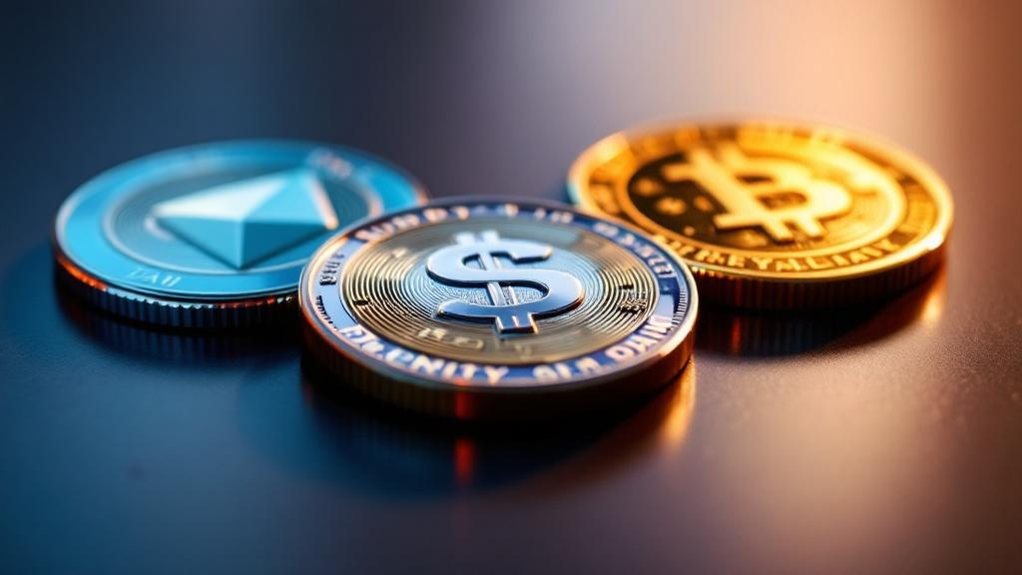

The quiet revolution in cryptocurrency isn’t found in volatile assets that make headlines for overnight millionaires—it’s happening in the steadfast world of stablecoins.
These digital currencies maintain a consistent value, typically pegged to the US dollar, offering shelter from crypto’s notorious price swings while preserving blockchain benefits.
USDT (Tether), the pioneer that launched in 2014, remains the heavyweight champion with a massive $117 billion market cap.
Like that friend who’s always ready to party but sometimes makes questionable life choices, USDT offers unmatched liquidity but carries transparency baggage—including a $30 million hack in 2017 and ongoing scrutiny about its reserve backing.
Enter USDC, the straight-A student of stablecoins.
Launched in 2018 by Circle with Coinbase’s blessing, it’s fully backed by dollars and short-term Treasuries with monthly audits to prove it.
At $34.9 billion market cap, it’s smaller than USDT but offers what many institutions crave: regulatory compliance and transparency.
Stablecoins provide essential stability in the volatile cryptocurrency market while enabling faster transactions than traditional banking systems.
Think of it as the sensible sedan to USDT’s sports car—less flashy, more reliable.
Meanwhile, DAI stands apart as cryptocurrency’s self-governing experiment.
Unlike its centralized cousins, this decentralized stablecoin is managed by MakerDAO’s community and backed by a basket of other cryptocurrencies through smart contracts.
No company controls it—the code and community do.
It’s like a financial democracy: sometimes messy but remarkably resilient.
Each serves distinct purposes in the crypto ecosystem.
USDT dominates trading pairs and arbitrage opportunities with its unmatched liquidity.
USDC has expanded beyond Ethereum to operate on multiple blockchain networks including Algorand and Solana, increasing its versatility across the crypto ecosystem.
USDC shines in compliant DeFi applications and institutional settlements.
DAI flourishes in decentralized finance where users prioritize censorship resistance and community governance.
USDC has recently demonstrated its growing market influence by surpassing USDT with over 17 trillion dollars in on-chain transaction volume in 2024.
The stablecoin you choose depends on your priorities: maximum liquidity (USDT), regulatory compliance (USDC), or decentralization (DAI).
As these digital dollars continue evolving, they’re transforming how people worldwide access stable value—proving that sometimes, cryptocurrency’s most revolutionary impact comes not from spectacular gains but consistent reliability.